
Like vs. As
English Grammar Rules
We generally use LIKE and AS to make comparisons.
LIKE
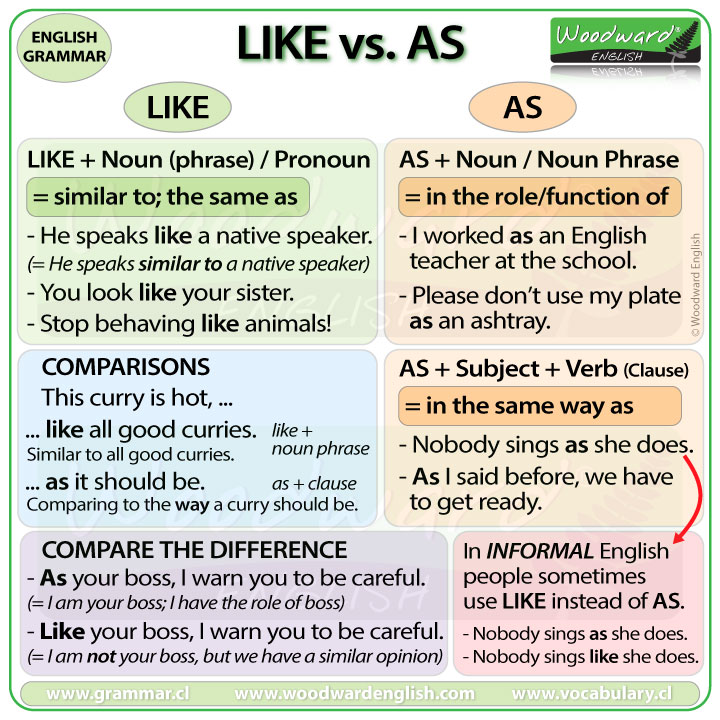
LIKE = similar to; the same as.
The structure of the sentence is usually: VERB + LIKE + NOUN / PRONOUN.
- He speaks like a native speaker. (= He speaks similar to a native speaker)
- She looks like a supermodel.
- You look like him.
- Stop behaving like animals!
LIKE is mainly used as a comparison.
AS
AS = the way; in the same way; in the same condition
The structure of the sentence is usually: AS + SUBJECT + VERB.
- Nobody sings as she does. (= Nobody sings in the same way she does)
- They went to the party as they were.
- Please don't use my plate as an ashtray.
- As I said before, we have to get ready.
Notice how you could replace AS with 'the way' or 'in the same way' and maintain the same meaning.
It is common in American English to use LIKE instead of AS. However, it is generally considered informal to use it in this way.
- We play football like champions do.
Another use of AS is to say what the role/position/function of a person/thing is.
- He started work as a carpenter.
- She used the tapestry as decoration in her living room.
- I worked as an English teacher at the school.
LIKE vs. AS
Be careful, in similar sentences that use LIKE and AS, the meanings of each sentence are very different. For example:
- As your boss, I must warn you to be careful. (I am your boss - I am in the role of boss - REALITY.)
- Like your boss, I must warn you to be careful. (I am not your boss, but he/she and I have a similar opinion. - COMPARISON)
Another example with different meanings:
- This curry is hot, like all good curries. (Like + Noun Phrase)
= Similar to all good curries - This curry is hot, as it should be. (As + Clause)
= Comparing to the way a curry should be. Notice how after AS there is a Subject + Verb (= a clause)
AS IF
In English we also use as if to make comparisons. However it has a few distinct characteristics to its use:
1. The verb after AS IF is always in the past subjunctive, no matter what tense the sentence is.
2. If the verb BE directly follows AS IF, we use were for all personal pronouns.
- He looks as if he knew the answer... but he doesn't.
(The verbs LOOKS indicates this sentence is in the present – but the verb after AS IF – knew - is in the past subjuntive).
- She walks as if she were a supermodel.
(The verb after AS IF – be – has been changed to were and not was).
- He boarded the airplane as if he were a seasoned traveller.
- He spends money as if he owned a bank.
Using AS + Adjective + AS
We use this structure to talk about people, animals or things which are equal in some way. This is a form of comparison.
- Chris is as tall as his brother.
Next activity
Try our interactive game to practice the difference between Like and As.
If you found this grammar guide about Grammar in English useful, let others know about it.


