
Do vs. Does
English Grammar Rules
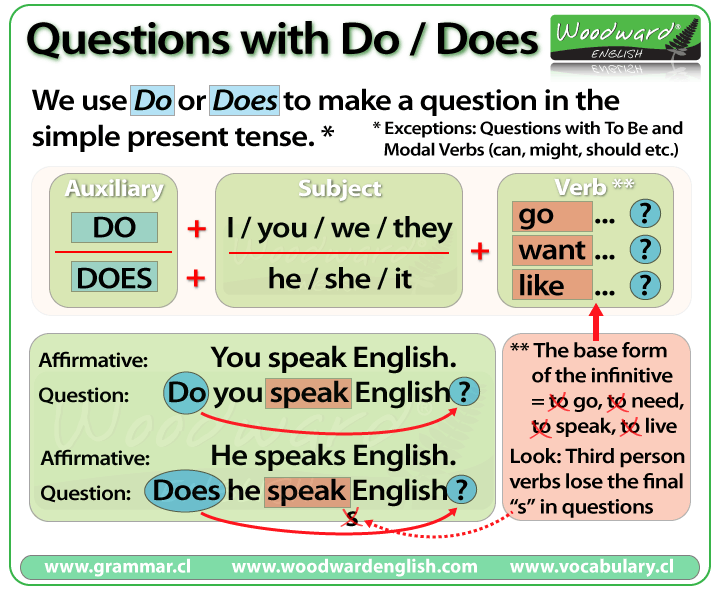
To make a question in English we normally use Do or Does. It is normally put at the beginning of the question (before the subject).
Affirmative: You speak Spanish.
Question: Do you speak Spanish?
You will see that we add DO at the beginning of the affirmative sentence to make it a question. We use Do when the subject is I, you, we or they.
Affirmative: He speaks Spanish.
Question: Does he speak Spanish?
When the subject is he, she or it, we add DOES at the beginning to make the affirmative sentence a question. Notice that the letter S at the end of the verb in the affirmative sentence (because it is in third person) disappears in the question. We will see the reason why below.
We DON'T use Do or Does in questions that have the verb To Be or Modal Verbs (can, must, might, should etc.)
Word Order of Questions with Do and Does
The following is the word order to construct a basic question in English using Do or Does.
| Do/Does | Subject | Verb* | The rest of the sentence |
|---|---|---|---|
| Do | I / you / we / they | have / buy eat / like etc. | cereal for breakfast? |
| Does | he / she / it |
*Verb: The verb that goes here is the base form of the infinitive = The infinitive without TO before the verb. Instead of the infinitive To have it is just the have part.
Remember that the infinitive is the verb before it is conjugated (changed) and it begins with TO. For example: to have, to eat, to go, to live, to speak etc.
Examples of Questions with Do and Does:
- Do you speak English?
- Does John speak French?
- Do we have time for a quick drink?
- Does it rain a lot in the South?
- Do they want to come with me?
- Does she like chocolate?
Short Answers with Do and Does
In questions that use do/does it is possible to give short answers to direct questions as follows:
| Sample Questions | Short Answer (Affirmative) | Short Answer (Negative) |
|---|---|---|
| Do you speak English? | Yes, I do. | No, I don't. |
| Do I need a dictionary? | Yes, you do. | No, you don't. |
| Do you both speak English? | Yes, we do. | No, we don't. |
| Do they speak English? | Yes, they do. | No, they don't. |
| Does he speak English? | Yes, he does. | No, he doesn't. |
| Does she speak English? | Yes, she does. | No, she doesn't. |
| Does it have four legs? | Yes, it does. | No, it doesn't. |
However, if a question word such as who, when, where, why, which or how is used in the question, you can not use the short answers above to respond to the question.
Question Words with Do and Does
The order for making sentences with Questions words is the following:
| Question Word | Do/Does | Subject | Verb |
|---|---|---|---|
| What | do | you | have for breakfast? |
| What | does | she | have for breakfast? |
| Where | do | you | live? |
| When | do | you | study? |
| How | do | you | spell your name? |
Practice Exercises
Next activities
Try our interactive game to practice Do and Does in Questions.
See our notes about the difference between Do, Does, Did and Done.
If you found this grammar guide about Do and Does in English useful, let others know about it.


