
Can - Cannot - Can't
English Grammar Notes
Can is a modal verb.
Can is used to express ability or to say that something is possible.
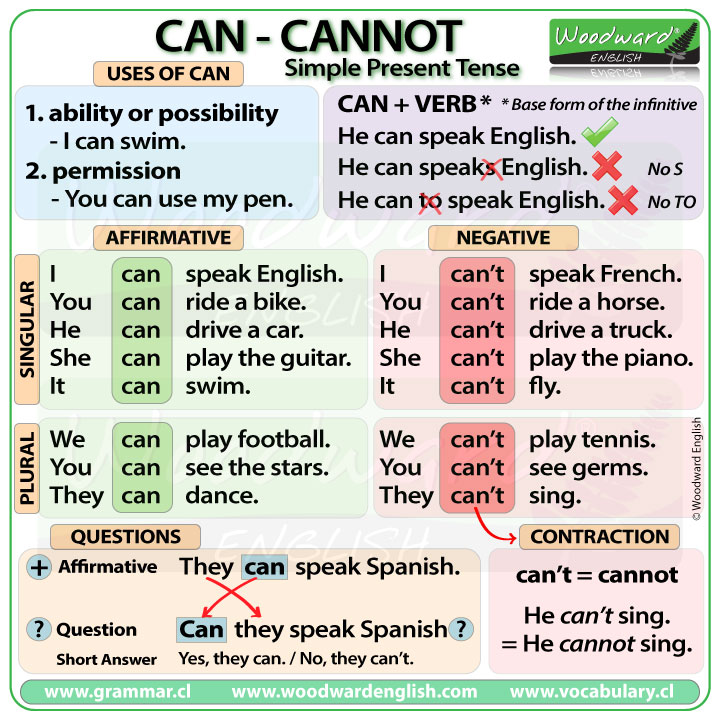
Can is the same for all subjects. We don't add an 'S' in the third person (like other verbs)
The verb that comes after Can is in the infinitive without to:
- I can speak Spanish. (= it is possible for me to speak Spanish = I have the ability to speak Spanish)
- He can swim well.
- We can see our neighbour in the garden.
- They can play the guitar.
For more uses of Can see: Modal Verbs: Can - Could
Negative
To form the negative we add "not" after can to form one word: cannot.
We can also contract the negative to form can't. (can't = cannot)
- I cannot play the piano. We can't go to the cinema tonight.
- She cannot speak French very well. He can't drive a car.
Questions
To from the question we change the position of the subject and the auxiliary verb.
The main verb is still in the infinitive without to.
- Where can I buy an ice-cream?
- Can I go to the party, please?
- Can you speak Japanese?
- What can we do on Saturday?
Remember that you can use short answers:
- Can I sit here please? Yes, you can.
- Can you speak Chinese? No, I can't.
Summary Chart
Impersonal Can
Sometimes You can and Can you…? are impersonal and refer to people in general.
- You can see many stars at night from here. (= people in general can see many stars)
It doesn't necessarily refer to you but people in general.
- You can't run naked in the middle of the street.
Not necessarily saying YOU can't run naked in the middle of the street but in general it is not possible for anyone.
Next activities
Try our Can - Can't - Cannot Game.
See our notes about Can and Could (Modal Verbs).
Speaking Practice: Answer the questions in this video
Download our free Can vs Cannot Worksheet (in PDF).
You can check the answers to this worksheet here: Can vs Cannot Answers.
If you found this grammar guide about CAN in English useful, let others know about it.


