
Countable vs. Uncountable Nouns
English Grammar Rules
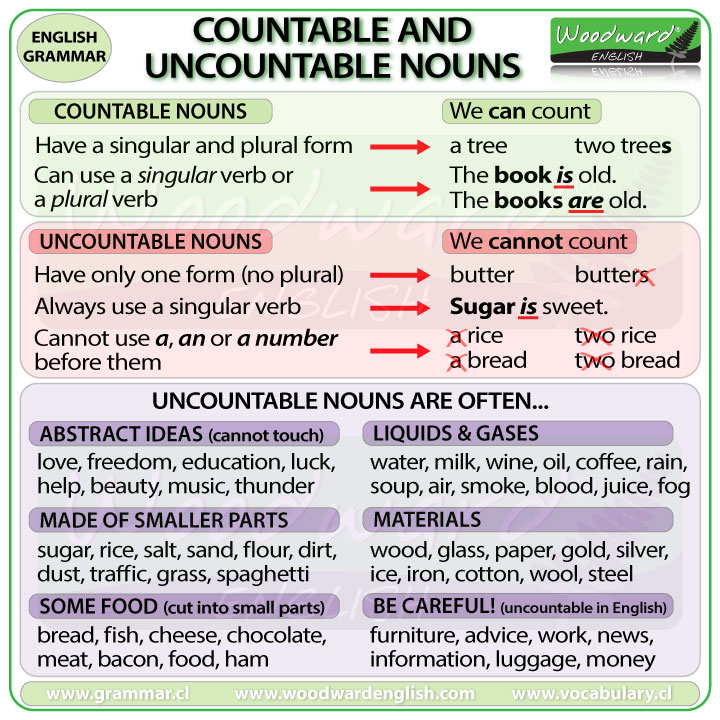
A) Most nouns have singular and plural forms. They are countable nouns.
e.g. One letter, two letters
- There is a letter on the table for you. (singular)
- There are letters on the table for you. (plural)
B) Some nouns only have one form. They are uncountable nouns.
e.g. Money
- There is no money in my bank account.
- There is a lot of money in my bank account.
C) Many uncountable nouns refer to substances:
e.g. Chocolate, water, coffee, milk, sugar, salt, cheese, bread, rice, wood, glass, plastic, soap, toothpaste.
- Do you have any chocolate?
- The milk is sour - let's make cheese.
- Rice is only edible when it has been cooked.
D) Many uncountable nouns refer to abstract ideas or emotions.
e.g. love, sadness, happiness, education, knowledge, and grammar.
- Money can't buy love.
- We like to experience happiness.
- This education is priceless.
E) You can use a/an with singular countable nouns.
e.g. an umbrella, a wheel, a mistake.
- It's raining so I need an umbrella.
- I made a mistake.
- This is a job for superman.
F) You can use plural countable nouns alone.
e.g. apples, bees, clouds.
- There are clouds in the sky today.
- There are bees making honey.
- We eat apples for breakfast.
G) You can't use an article with an uncountable noun.
e.g. time, sand, electricity.
- We need electricity to use our heater.
- I lost track of time and we stayed up very late.
- The beaches in Brazil have very nice sand.
H) It is very common in English to use some / any with plural nouns and uncountable nouns (Refer to grammar notes on Some Any for more details).
e.g. They don't listen to any advice.
- We don't have any toys for the children.
- There are many lessons in life, this is just one more.
- It is important to have some knowledge of grammar.
I) There are a range of nouns that are uncountable in English but are countable in other languages.
These include: accommodation, advice, baggage, behaviour, bread, chaos, damage, furniture, information, luck, luggage, news, permission, progress, scenery, traffic, weather and work.
J) For comparison purposes, look at these sentences:
| Countable | Uncountable |
|---|---|
| I'm looking for a job. | I'm looking for work. |
| What a beautiful view! | What beautiful scenery! |
| It's a nice day today. | It's nice weather today. |
| We had a lot of bags and suitcases. | We had a lot of luggage. |
| These chairs are mine. | This furniture is mine. |
| It was a good suggestion. | It was good advice. |
Summary Chart
Next activity
To practice Countable and Uncountable nouns, try this Game.
Learn the difference between Some and Any
See our notes about other Types of Nouns.
If you found this grammar guide about Countable and Uncountable nouns in English useful, let others know about it.


